E With an Accent
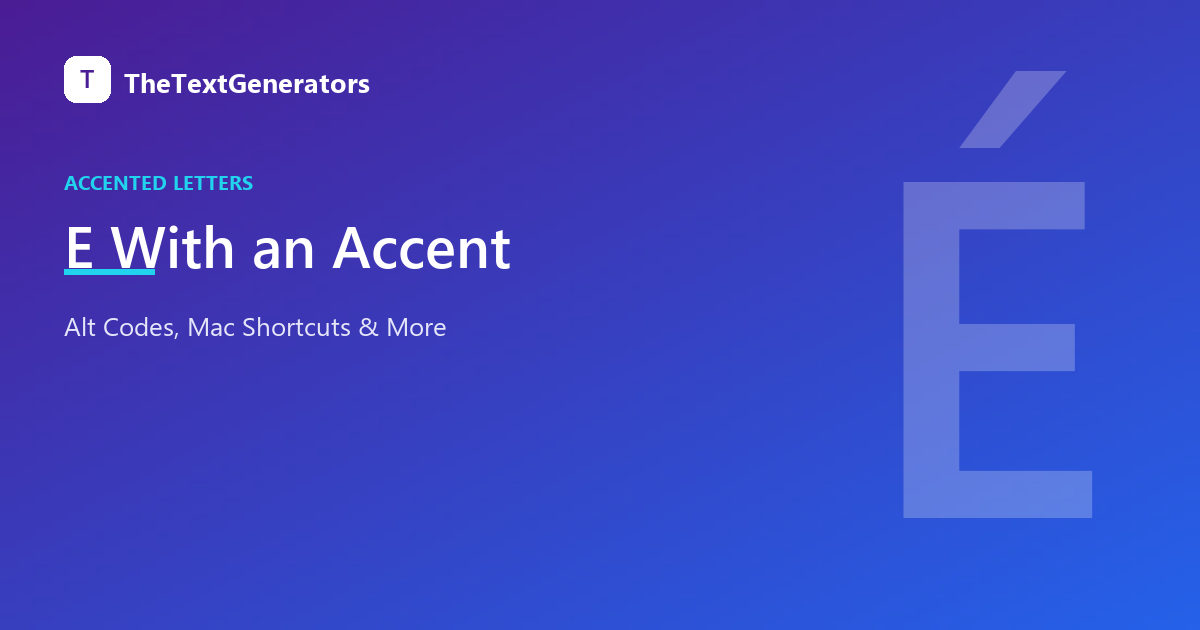
There are four accented forms of E in common use: é (acute), è (grave), ê (circumflex), and ë (diaeresis, also called an umlaut). Each is a genuine Unicode character with its own code point — not a font effect — so once you have the right one, it copies and pastes exactly like any other letter.
- é acute — French accent aigu, also common in Spanish, Portuguese and Italian
- è grave — French accent grave, also used in Italian
- ê circumflex — French accent circonflexe
- ë diaeresis — French tréma, occasionally seen in English names
Which Accent Does E Use, and in What Language?
These four marks aren’t interchangeable — each one means something specific. The acute (é) marks a closed “ay” sound in French (café, fiancé) and is also the everyday accent in Spanish and Portuguese. The grave (è) marks an open “eh” sound in French (mère, très) and appears constantly in Italian (città, perché).
The circumflex (ê) has a quieter job: in French, it frequently marks a letter — almost always an s — that existed in Old French and was later dropped from spelling (forêt once had an s, so did tête and hôpital). It’s a small piece of the word’s history hiding in plain sight, not decoration.
The diaeresis (ë) does the opposite of blending letters — it tells you two vowels next to each other are pronounced separately, not as one sound. That’s why Noël is “no-el,” not “nol.” A handful of English names carry it for the same reason: Chloë, Brontë, Zoë.
Where E-Accent Confusion Happens
The clearest real-world case in English is résumé versus resume. Written with both accents, résumé is the noun for a CV. Written as “resume” with no accent, it’s the verb meaning to continue. Same letters, completely different word, and the accent is the only thing telling them apart in writing.
A second common mix-up: café is not pronounced the same as an anglicized “cafe.” The é signals stress on the second syllable (kaf-AY) — drop the accent in casual English writing and the word survives, but the pronunciation cue goes with it.
Spanish has its own minimal pair here: él (he) versus el (the). Both are among the most common words in the language, and the accent is the only thing distinguishing the pronoun from the article — “él tiene” (he has) reads completely differently from “el tiene” if a proofreader assumes the second is just a typo.
How to Type É, È, Ê or Ë
- On Windows — hold Alt and type the numeric code on your numpad: 0233 for é, 0201 for É, 0232 for è, 0200 for È, 0234 for ê, 0202 for Ê, 0235 for ë, 0203 for Ë.
- On Mac — each accent has its own modifier key, then the letter: Option+E then E gives é, Option+` then E gives è, Option+I then E gives ê, Option+U then E gives ë. Add Shift for the capital.
- Fastest option — open the Accent Letters Generator, search “e accent,” and click any variant to copy it directly — no codes to remember.
Common Words With an Accented E
café, résumé, fiancé, fiancée, cliché, entrée, exposé, née, protégé, décor.
FAQ
Does résumé need one accent or two?
Two — both es carry the same acute accent (résumé), though “resumé” with just one is also seen informally. Either way, it’s the accent that separates the noun from the verb “resume.”
Do I actually need the accent for résumé to be correct English?
No — English has fully adopted “resume” without accents as acceptable, especially in the US. The accented version is more formal and avoids any ambiguity with the verb.
Will é, è, ê and ë display correctly everywhere?
Yes, on any modern device or browser. These are standard Unicode Latin-1 characters supported everywhere plain text is — no special font needed.
Does Spanish use e with an accent the same way as French?
No — Spanish only ever uses the acute (é) to mark stress, never the grave, circumflex or diaeresis forms French uses. É is common in Spanish (café, después), while è, ê and ë don’t appear in standard Spanish spelling at all.
Is there a single tool for all four accented E variants, upper and lower case?
Yes — the Accent Letters Generator covers all four E accents in both cases, plus every other commonly accented Latin letter, with Windows, Mac and HTML codes for each.
Related Guides
See also: Résumé With an Accent and How to Type Accented Letters on every platform.
More Accented Letters
Browse A With an Accent, O With an Accent, or the full Accent Letters Generator.

Iqbal Hossen Juel
Iqbal Hossen Juel is the creator and developer of TheTextGenerators.com, a free suite of 86 Unicode text-styling tools used for social media bios, usernames, and creative typography.
Connect on LinkedIn →