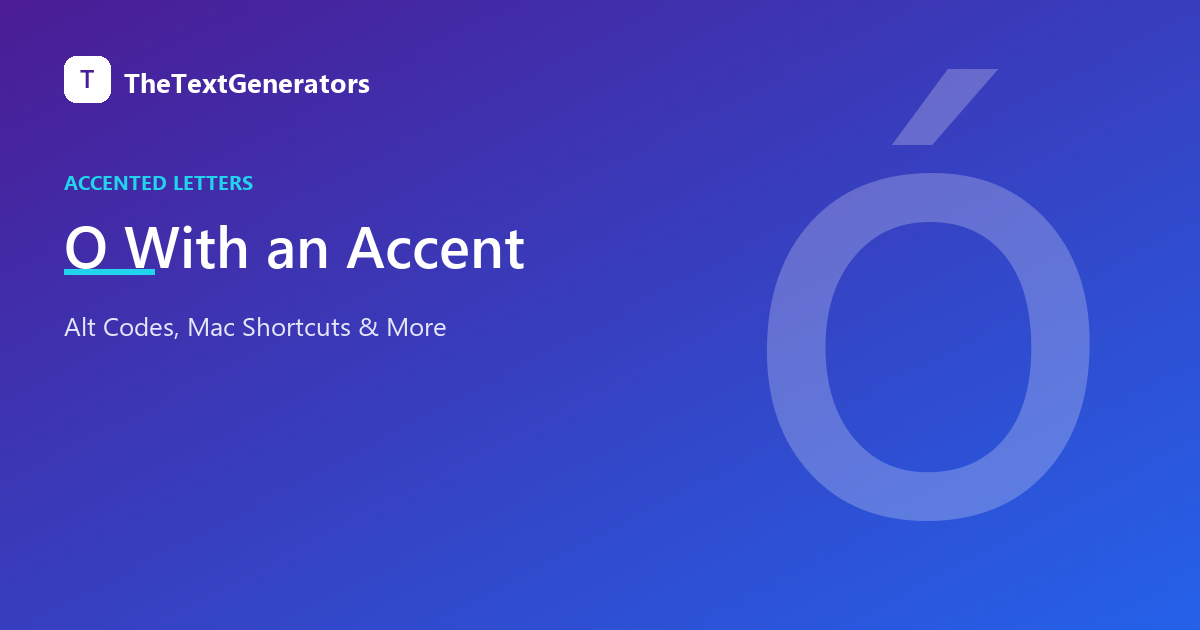
O With an Accent
O appears with five accents in everyday use: ó (acute), ò (grave), ô (circumflex), ö (umlaut/diaeresis), and õ (tilde). All five are real Unicode characters, not stylized fonts, so they copy and paste like ordinary text.
- ó acute — Spanish, Portuguese, Polish and Hungarian
- ò grave — Italian and Catalan
- ô circumflex — French
- ö umlaut — German, Swedish, Finnish and Turkish
- õ tilde — Portuguese and Estonian
Which Accent Does O Use, and in What Language?
Spanish and Portuguese use ó constantly to mark stress on a syllable that would otherwise be read differently — camión, José, número. Italian and Catalan use ò the same way for open, stressed vowel sounds.
French ô is another case of a circumflex marking history rather than sound: côte (coast) and hôtel both descend from Latin words that had an s — costa, hospitalis — which French dropped from spelling but preserved as a circumflex.
German ö is a completely different vowel sound from o, not a stress marker — leaving it off doesn’t just look wrong, it changes the word. Portuguese õ marks a nasal vowel, heard in words like põe and the poet’s name Camões.
Where O-Accent Confusion Happens
The clearest example is German: schon (already) and schön (beautiful) are different words entirely — the umlaut isn’t optional styling, it’s the only thing separating them in writing and speech.
A lighter case: some rock and metal bands (Mötley Crüe, Motörhead) add umlauts purely for visual effect, with no actual pronunciation change intended. It’s a fun example of the same character being used two completely different ways — genuine linguistic function in German, pure aesthetic in English band names.
How to Type Ó, Ò, Ô, Ö or Õ
- On Windows — hold Alt and type the code: 0243 for ó, 0211 for Ó, 0242 for ò, 0210 for Ò, 0244 for ô, 0212 for Ô, 0246 for ö, 0214 for Ö, 0245 for õ, 0213 for Õ.
- On Mac — Option+E then O gives ó, Option+` then O gives ò, Option+I then O gives ô, Option+U then O gives ö, Option+N then O gives õ. Add Shift for the capital.
- Fastest option — open the Accent Letters Generator and click any O variant directly.
Common Words With an Accented O
número, José, camión, côte, hôtel, rôle, schön, señor’s neighbor “por favor,” põe.
FAQ
Is ö the same as a regular o with dots added for style?
No — in German, Swedish and Finnish it’s a distinct vowel with its own sound, not a decorated o. Dropping it can turn one real word into a different one.
Why do some band names use ö when English doesn’t need it?
It’s a stylistic choice with no linguistic function in English — sometimes called a “metal umlaut.” It borrows the visual weight of German without borrowing the pronunciation rule.
Will ó, ò, ô, ö and õ display correctly everywhere?
Yes — all five are standard Unicode characters supported on every modern device and browser, no special font required.
Does Spanish use o with an accent?
Yes, but only the acute — ó marks stress in words like camión and José. Spanish doesn’t use the grave, circumflex, umlaut or tilde forms (ò, ô, ö, õ) that Italian, French, German and Portuguese use for O.
Is there one tool that covers every accented O, upper and lower case?
Yes — the Accent Letters Generator includes all five O accents in both cases, alongside every other commonly accented Latin letter.
More Accented Letters
Browse E With an Accent, U With an Accent, Ø With a Line Through It (a different O-based letter, not an accent), or the full Accent Letters Generator.

Iqbal Hossen Juel
Iqbal Hossen Juel is the creator and developer of TheTextGenerators.com, a free suite of 86 Unicode text-styling tools used for social media bios, usernames, and creative typography.
Connect on LinkedIn →