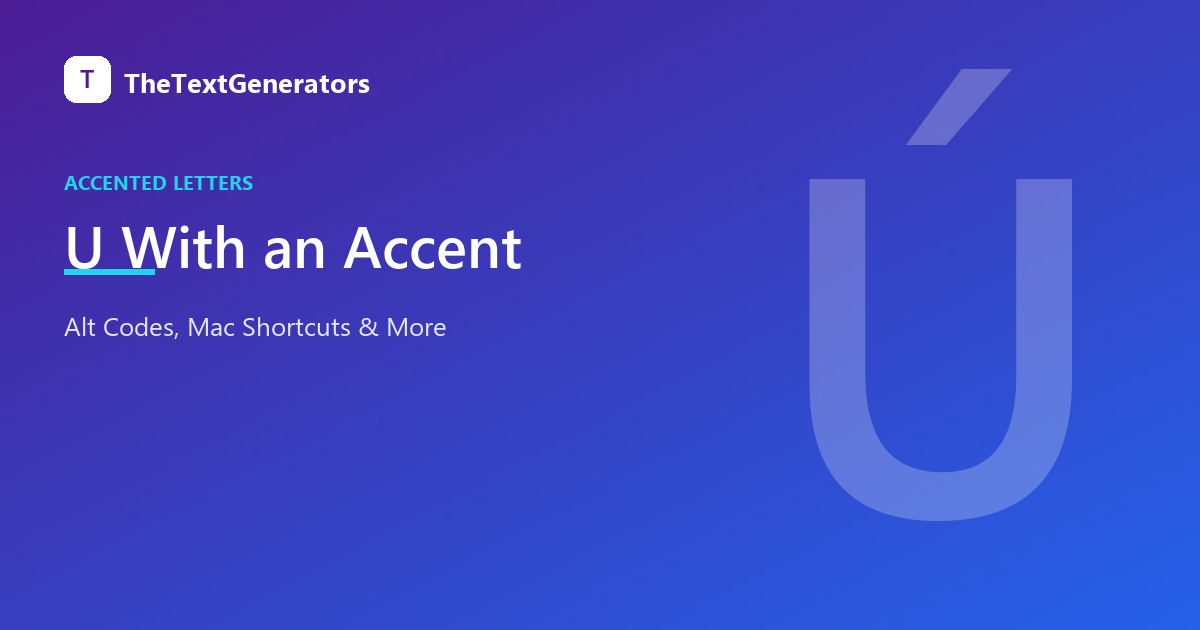
U With an Accent
U appears with four accents in common use: ú (acute), ù (grave), û (circumflex), and ü (umlaut/diaeresis). All four are genuine Unicode characters, so they behave exactly like any other letter once copied.
- ú acute — Spanish and Portuguese
- ù grave — French and Italian
- û circumflex — French
- ü umlaut — German and Spanish
Which Accent Does U Use, and in What Language?
Spanish and Portuguese use ú the same way they use every other acute accent: to mark a stressed syllable that would otherwise be misread — número, música, único. French ù is rarer than most accents and, like à, is mostly grammatical rather than phonetic (more below).
French û is another circumflex marking a dropped historical letter — sûr (sure) and goût (taste) both once had an s in the spelling. German ü is a genuinely different vowel sound from u, the same way ö differs from o.
Spanish ü has one very specific job: in “gue” and “gui” combinations, the u is normally silent (guerra is pronounced without the u). Adding the diaeresis — güe, güi — signals the u should actually be pronounced, as in pingüino (penguin) or bilingüe (bilingual).
Where U-Accent Confusion Happens
French has a near-perfect minimal pair here: où (where) and ou (or) are two entirely different words separated only by the grave accent. It’s the same trick as à versus a — same letters, same sound, different grammatical function entirely.
In Spanish, dropping ü from pingüino doesn’t just look wrong — without the diaeresis, the spelling “pinguino” reads as if the u were silent, which isn’t how the word is actually said.
Spanish has its own minimal pair with U, though the accent here isn’t on the u itself: tú (you) and tu (your) are separated only by the acute accent. “Tú tienes” (you have) and “tu tienes” look almost identical typed quickly, but only one is grammatically correct.
How to Type Ú, Ù, Û or Ü
- On Windows — hold Alt and type the code: 0250 for ú, 0218 for Ú, 0249 for ù, 0217 for Ù, 0251 for û, 0219 for Û, 0252 for ü, 0220 for Ü.
- On Mac — Option+E then U gives ú, Option+` then U gives ù, Option+I then U gives û, Option+U then U gives ü. Add Shift for the capital.
- Fastest option — open the Accent Letters Generator and click any U variant directly.
Common Words With an Accented U
número, música, único, où, sûr, goût, pingüino, bilingüe.
FAQ
Is où just a stylized version of ou?
No — in French they’re two different words. Où means “where,” ou means “or.” The accent is the only thing telling a reader which one is meant.
Why does Spanish sometimes put two dots over ü specifically?
It’s a pronunciation flag: after g, before ue or ui, the u is normally silent. The diaeresis (ü) tells you to pronounce it anyway, as in pingüino.
Will ú, ù, û and ü display correctly everywhere?
Yes — all four are standard Unicode characters supported on every modern device and browser, no special font required.
Does Spanish use u with an accent the same way as French?
Not quite — Spanish uses ú for stress (número) and ü only in “güe”/”güi” combinations (pingüino). It doesn’t use the grave (ù) or plain circumflex (û) forms that French relies on.
Is there one tool for every accented U, upper and lower case?
Yes — the Accent Letters Generator covers all four U accents in both cases, plus every other commonly accented Latin letter.
More Accented Letters
Browse O With an Accent, I With an Accent, Y With an Accent, or the full Accent Letters Generator.

Iqbal Hossen Juel
Iqbal Hossen Juel is the creator and developer of TheTextGenerators.com, a free suite of 86 Unicode text-styling tools used for social media bios, usernames, and creative typography.
Connect on LinkedIn →