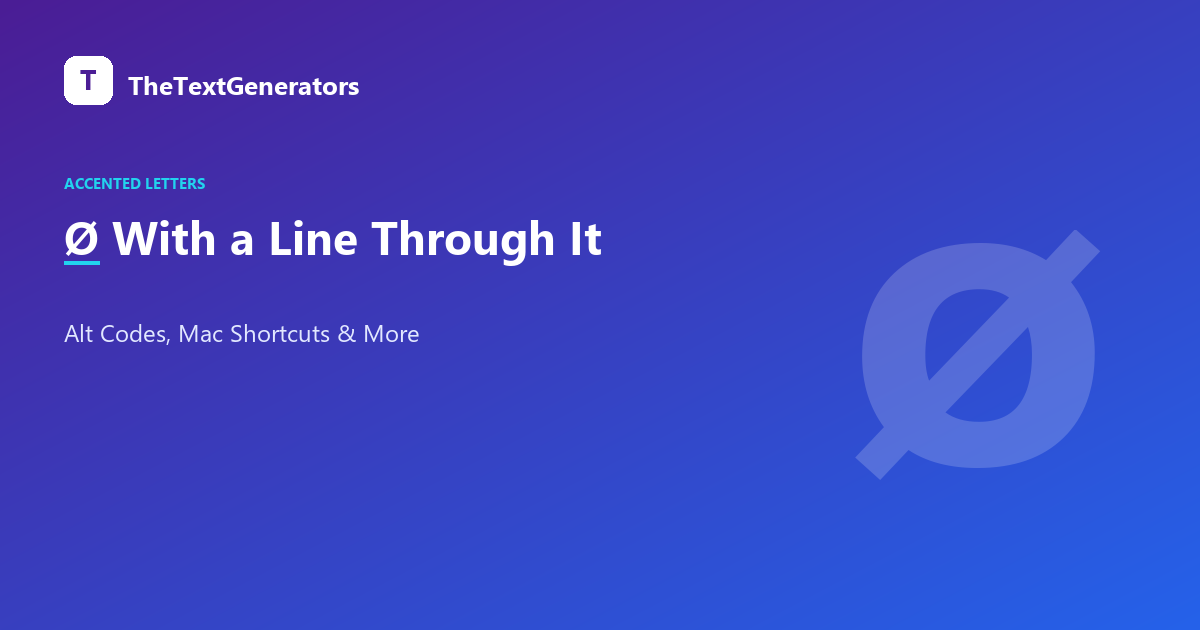
O With a Line Through It (Ø)
The letter people are picturing when they search “o with a line through it” is almost always Ø (capital) or ø (lowercase) — a real Unicode letter, not a stylized O. It copies and pastes exactly like plain text, and it’s the letter used in Danish, Norwegian and Faroese.
Ø Isn’t an Accented O — It’s a Separate Letter (and It Has Two Lookalikes)
Like Ñ, Ø isn’t a decorated version of another letter. In Danish and Norwegian, Ø sits at the very end of the alphabet, after Z — right alongside Æ and Å. It comes from the same medieval habit that produced Æ: scribes writing the ligature of O and E (œ) gradually simplified it into a single O with a line struck through it, and that stroke became a permanent, distinct letter rather than a decoration.
The confusion runs deeper than most letters, because Ø has two other characters that look nearly identical but mean something completely different:
- Ø / ø — the actual Latin letter, used in real words in Danish, Norwegian and Faroese
- ∅ — the mathematical “empty set” symbol, used in set theory to mean “contains nothing”
- ⌀ — the engineering “diameter” symbol, used on technical drawings to mean “this measurement is a diameter”
All three are separate Unicode characters. Copying the wrong one into a document — using the letter Ø where a technical drawing needs ⌀, for example — is a real, recurring mistake in CAD and drafting work, not just a typing nitpick.
Where Ø Confusion Happens
The clearest everyday example is a place name: København — Copenhagen’s actual Danish spelling — uses ø in a word most English speakers only ever see spelled phonetically. Drop the ø and replace it with a plain o, and native speakers will immediately read it as misspelled, the same way schon/schön are different words in German.
A well-known modern example: Røyksopp, the Norwegian electronic duo, spells its name with ø — not a stylized o, and not interchangeable with one, even though it often gets typed as “Royksopp” online out of convenience.
On the technical side, engineering drawing standards (ISO 129-1) specifically define ⌀ as the diameter symbol precisely because Ø, the letter, kept getting confused with it when people typed a plain letter O with a slash instead of the dedicated symbol.
How to Type Ø or ø
- On Windows — hold Alt and type 0216 for Ø, or 0248 for ø.
- On Mac — Option+O gives ø directly (no dead key), and Option+Shift+O gives Ø. This is a one-step shortcut, the same style as å or ç, not a two-key sequence like é.
- In HTML — use
Øfor Ø andøfor ø. - Fastest option — open the Accent Letters Generator, search “o with stroke,” and click to copy.
- If you actually wanted ∅ or ⌀ — those aren’t Ø. The empty-set symbol ∅ is Unicode U+2205, and the diameter symbol ⌀ is U+2300; most word processors insert them through a Symbol/Special Characters menu rather than an Alt code.
Common Words With Ø
øl (beer), København, Bjørn, Røyksopp, Færøerne (the Faroe Islands in Danish).
FAQ
Is “o with a line through it” the same as the empty-set symbol ∅?
No — they look alike but are different Unicode characters with different meanings. Ø is a letter used in real Danish, Norwegian and Faroese words; ∅ is a math symbol meaning “the empty set.”
Is Ø the same as the diameter symbol ⌀ used on engineering drawings?
No, though they’re visually close enough to cause real mix-ups. ⌀ is a dedicated technical symbol defined by ISO drafting standards specifically to avoid being confused with the letter Ø.
Does Norwegian or Danish use Ø with an accent mark on top?
No — Ø is its own letter, not an accented O. It doesn’t take additional accent marks the way a, e or o do.
Will Ø display correctly everywhere?
Yes — it’s a standard Unicode character (U+00D8 / U+00F8) supported on every modern device, browser and font, no special setup required.
Does the Accent Letters Generator include Ø?
Yes — alongside every other commonly used accented and special Latin letter.
More Accented (and Not-Quite-Accented) Letters
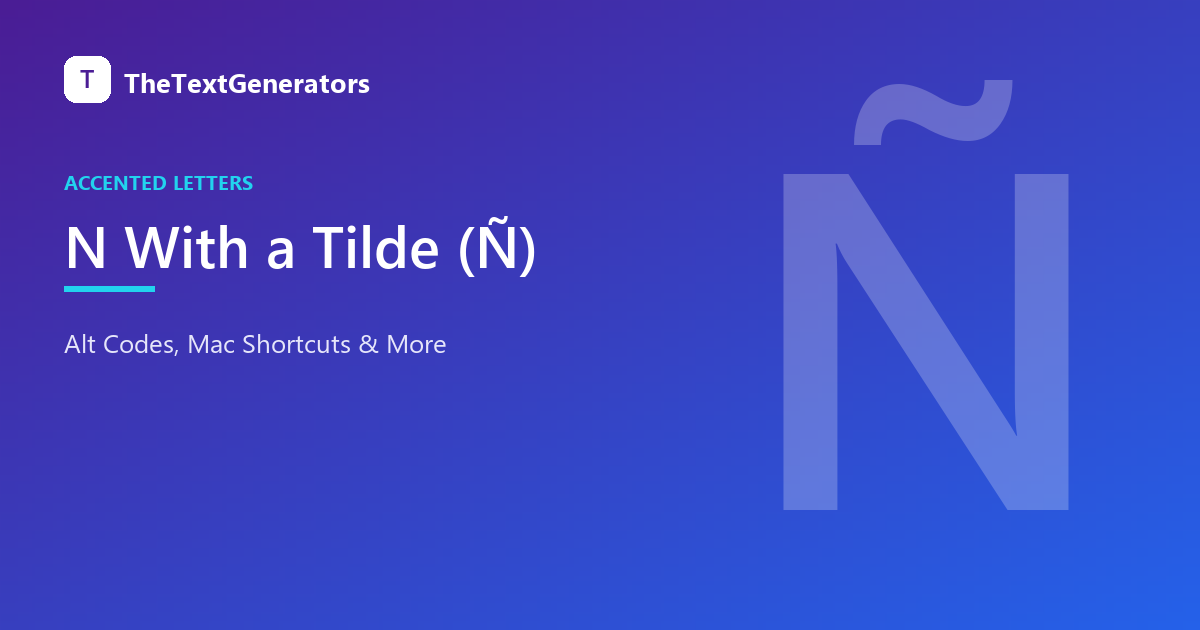
Browse O With an Accent, N With an Accent (Ñ) — another letter that isn’t really an accent either — or the full Accent Letters Generator.

Iqbal Hossen Juel
Iqbal Hossen Juel is the creator and developer of TheTextGenerators.com, a free suite of 86 Unicode text-styling tools used for social media bios, usernames, and creative typography.
Connect on LinkedIn →