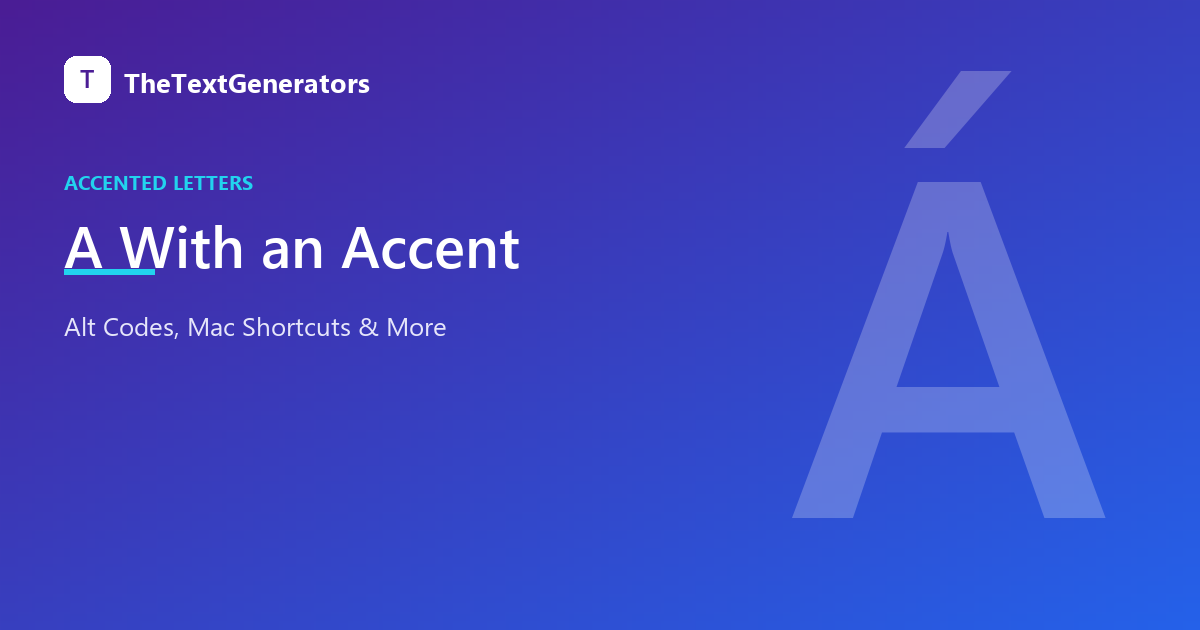
A With an Accent
A takes six accented forms in common use: á (acute), à (grave), â (circumflex), ä (umlaut/diaeresis), ã (tilde), and å (ring). Every one is a real Unicode character, so it copies and pastes exactly like plain text — no special font needed.
- á acute — Spanish, Portuguese, Czech and Hungarian
- à grave — French and Italian
- â circumflex — French, Portuguese and Romanian
- ä umlaut — German, Swedish and Finnish
- ã tilde — Portuguese
- å ring — Swedish, Danish and Norwegian
Which Accent Does A Use, and in What Language?
Spanish and Portuguese use á purely to mark stress — está, María, número already end in accented syllables that would otherwise be read wrong. French à is different: it’s rarely about pronunciation and mostly a grammar marker (more on that below).
Portuguese ã marks a nasal vowel sound with no real English equivalent — heard at the start of São Paulo. German ä, like ö, is a distinct vowel sound rather than a decorated a; leaving it off changes the word, not just the spelling.
Å has an unusual double life in Scandinavian languages: beyond regular words, it’s used as a standalone word in Swedish and Norwegian meaning “small stream,” which is why it turns up constantly in Scandinavian place names.
Where A-Accent Confusion Happens
French draws a hard line between à and a that has nothing to do with pronunciation and everything to do with grammar: “il a” means “he has” (from the verb avoir), while “il va à Paris” means “he goes to Paris” — à means “to” or “at.” Same letter, same sound, completely different grammatical job.
Portuguese ã is easy to drop in casual typing, but São Paulo without its tilde isn’t just a spelling shortcut — the nasal sound the tilde represents is part of how the name is actually pronounced.
How to Type Á, À, Â, Ä, Ã or Å
- On Windows — hold Alt and type the code: 0225 for á, 0193 for Á, 0224 for à, 0192 for À, 0226 for â, 0194 for Â, 0228 for ä, 0196 for Ä, 0227 for ã, 0195 for Ã, 0229 for å, 0197 for Å.
- On Mac — Option+E then A gives á, Option+` then A gives à, Option+I then A gives â, Option+U then A gives ä, Option+N then A gives ã. Å is a direct combo: Option+A alone. Add Shift for capitals.
- Fastest option — open the Accent Letters Generator and click any A variant directly.
Common Words With an Accented A
está, María, à la carte, déjà vu, São Paulo, café’s cousin “château,” ångström.
FAQ
Is à just a stylized version of a?
No — in French, à and a are two different words with different jobs (à means “to/at,” a is a form of “to have”). The accent is grammatical, not decorative.
Why does å get its own key on Scandinavian keyboards?
It’s a fully independent letter in Swedish, Norwegian and Danish, sorted after z in the alphabet, not treated as an accented variant of a the way é is treated as a variant of e in French.
Will á, à, â, ä, ã and å display correctly everywhere?
Yes — all six are standard Unicode characters supported on every modern device and browser.
Does Spanish use a with an accent?
Yes, but only the acute — á marks stress in words like está and María. Spanish doesn’t use the grave, circumflex, umlaut, tilde or ring forms that à, â, ä, ã and å represent in other languages.
Is there one tool for every accented A, upper and lower case?
Yes — the Accent Letters Generator covers all six A accents in both cases, plus every other commonly accented Latin letter.
More Accented Letters
Browse E With an Accent, N With an Accent, or the full Accent Letters Generator.

Iqbal Hossen Juel
Iqbal Hossen Juel is the creator and developer of TheTextGenerators.com, a free suite of 86 Unicode text-styling tools used for social media bios, usernames, and creative typography.
Connect on LinkedIn →